reCAPTCHA v3

The task is executed through our own proxy servers. There are no additional costs for proxies — their usage is already included in the service price.
This section describes the task for solving Google reCAPTCHA v3.
reCAPTCHA v3 operates entirely in the background and does not require any user interaction. The system analyzes behavioral and technical signals of the page visitor and generates a risk score for each request. Based on this data, the website decides whether to allow the action using a trust score, which typically ranges from 0.1 to 0.9.
When creating a task, it is recommended to provide two parameters: pageAction and minScore.
Request parameters
type<string>requiredRecaptchaV3TaskProxyless
websiteURL<string>requiredAddress of a webpage with Google ReCaptcha.
websiteKey<string>requiredRecaptcha website key.
https://www.google.com/recaptcha/api.js?render=THIS_ONE
isEnterprise<boolean>optionalreCAPTCHA version. Supported values: true / false (also 1 / 0, integer type).
Set true if you need to solve the reCAPTCHA as Enterprise — in this case, the task will be processed the same way as RecaptchaV3EnterpriseTask.
minScore<double>optionalValue from 0.1 to 0.9
pageAction<string>optionalWidget action value. Website owner defines what user is doing on the page through this parameter. Default value: verify
Example:grecaptcha.execute('site_key', {action:'login_test'}).
Create task method
https://api.capmonster.cloud/createTask
Request
{
  "clientKey": "API_KEY",
  "task": {
    "type": "RecaptchaV3TaskProxyless",
    "websiteURL": "https://lessons.zennolab.com/captchas/recaptcha/v3.php?level=beta",
    "websiteKey": "6Le0xVgUAAAAAIt20XEB4rVhYOODgTl00d8juDob",
    "isEnterprise": false,
    "minScore": 0.7,
    "pageAction": "myverify"
  }
}
Response
{
  "errorId":0,
  "taskId":407533072
}
Get task result method
On some websites, it is important that the UserAgent matches the one used when solving the captcha. Therefore, if CapMonster Cloud returns a UserAgent along with the token, always apply it when submitting the form or confirming the solution on the target page.
Use the getTaskResult to request answer for ReCaptcha3. You will get response within 10 - 30 sec period depending on service workload.
https://api.capmonster.cloud/getTaskResult
Request
{
  "clientKey":"API_KEY",
  "taskId": 407533072
}
Response
{
  "errorId": 0,
  "status": "ready",
  "solution": {
    "gRecaptchaResponse": "3AHJ_VuvYIBNBW5yyv0zRYJ75VkOKvhKj9_xGBJKnQimF72rfoq3Iy-DyGHMwLAo6a3"
  }
}
For some websites, the response may look like the following. When submitting the solution, make sure to use the UserAgent provided in the response, even if it differs from the one currently used by your browser or script.
{
  "errorId": 0,
  "status": "ready",
  "solution": {
    "userAgent": "Mozilla/5.0 (Windows NT 10.0; Win64; x64) AppleWebKit/537.36 (KHTML, like Gecko) Chrome/139.0.0.0 Safari/537.36",
    "gRecaptchaResponse": "0cAFcWeA5Y3...hF8UWA",
    "cookies": {
      "nocookies": "true"
    }
  }
}
| Property | Type | Description |
|---|---|---|
| gRecaptchaResponse | String | Hash which should be inserted into Recaptcha3 submit form in <textarea id="g-recaptcha-response" ></textarea>. It has a length of 500 to 2190 bytes. |
How to find all required parameters for task creation
Manually
- Open your website where the captcha appears in the browser.
- Right-click on the captcha element and select Inspect.
websiteKey
The public site key (sitekey). Usually, it can be found in the included script:
In Elements:
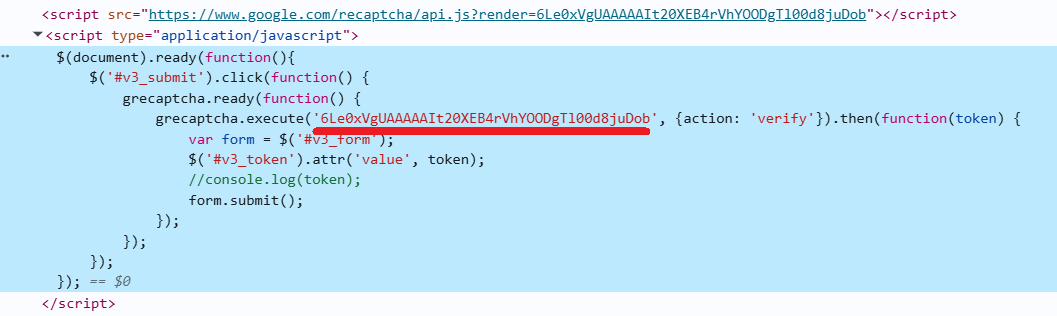
In the Network tab:

pageAction
The action name passed to grecaptcha.execute(). For example:
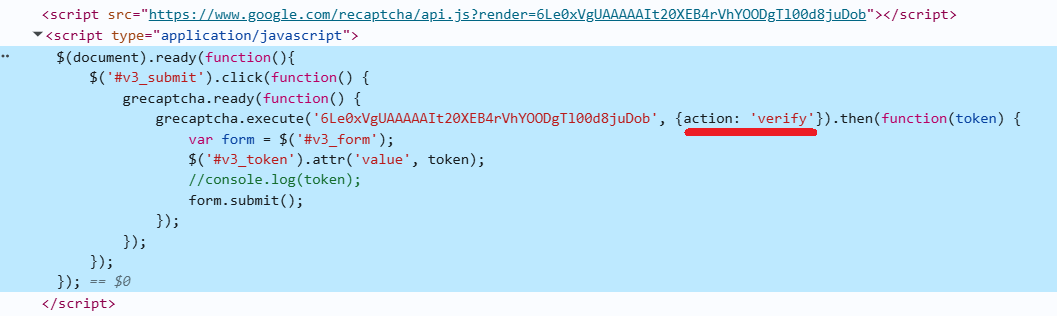
Automatically
To automate parameter extraction, you can retrieve them via a browser (regular or headless, e.g., using Playwright) or directly from HTTP requests. Since dynamic parameter values are short-lived, it is recommended to use them immediately after retrieval.
The provided code snippets are basic examples for learning how to extract the required parameters. The exact implementation will depend on your captcha page, its structure, and the HTML elements and selectors used.
- JavaScript
- Python
- C#
Show code (in browser)
(() => {
    const originalGrecaptcha = window.grecaptcha;

    if (!originalGrecaptcha || !originalGrecaptcha.execute) {
        console.warn("grecaptcha.execute not found. Wait until it loads.");
        return;
    }

    window.__extractedParams = null;

    window.grecaptcha = {
        ...originalGrecaptcha,
        execute: function(sitekey, config) {
            console.log("Captured!");
            console.log("sitekey:", sitekey);
            console.log("action:", config?.action);
            window.__extractedParams = {
                sitekey,
                action: config?.action
            };

            return originalGrecaptcha.execute(sitekey, config);
        },
        ready: originalGrecaptcha.ready
    };

    console.log("grecaptcha.execute is wrapped. Click the button - parameters will be captured.");
})();
Show code (Node.js)
import { chromium } from "playwright";

(async () => {
  const browser = await chromium.launch({ headless: false });
  const context = await browser.newContext();
  const page = await context.newPage();

  const jsContents = [];

  page.on("response", async (response) => {
    try {
      const url = response.url();
      const ct = response.headers()["content-type"] || "";
      if (ct.includes("javascript") || url.endsWith(".js")) {
        const text = await response.text();
        jsContents.push(text);
      }
    } catch (e) {}
  });

  const targetUrl = "https://lessons.zennolab.com/captchas/recaptcha/v3.php?level=beta";
  await page.goto(targetUrl, { timeout: 60000 });
  await page.waitForTimeout(3000);

  const inlineScripts = await page.$$eval("script:not([src])", (scripts) =>
    scripts.map((s) => s.textContent)
  );
  jsContents.push(...inlineScripts);

  const executeRegex =
    /grecaptcha\.execute\(\s*['"]
    (?<sitekey>[^'"]+)['"]\s*,\s*\{[^}]*action\s*:\s*['"](?<action>[^'"]+)['"]/i;

  let foundSitekey = null;
  let foundAction = null;

  for (const js of jsContents) {
    const match = js.match(executeRegex);
    if (match && match.groups) {
      foundSitekey = match.groups.sitekey;
      foundAction = match.groups.action;
      break;
    }
  }

  console.log({
    sitekey: foundSitekey,
    action: foundAction,
  });

  await browser.close();
})();
Show code
import asyncio
import re
from playwright.async_api import async_playwright

async def extract_recaptcha_v3_execute(url):
    async with async_playwright() as p:
        browser = await p.chromium.launch(headless=False)
        context = await browser.new_context()
        page = await context.new_page()

        execute_pattern = re.compile(
            r"grecaptcha\.execute\(\s*['\"]"
            r"(?P<sitekey>[^'\"]+)['\"]\s*,\s*\{[^}]*action\s*:\s*['\"](?P<action>[^'\"]+)['\"]",
            re.IGNORECASE
        )

        found_sitekey = None
        found_action = None
        js_contents = []

        async def handle_response(response):
            try:
                ct = response.headers.get("content-type", "")
                if "javascript" in ct or response.url.endswith(".js"):
                    text = await response.text()
                    js_contents.append(text)
            except:
                pass

        page.on("response", handle_response)

        await page.goto(url, timeout=60000)
        await page.wait_for_timeout(3000)

        inline_scripts = await page.locator("script:not([src])").all_text_contents()
        js_contents += inline_scripts

        for js in js_contents:
            match = execute_pattern.search(js)
            if match:
                found_sitekey = match.group("sitekey")
                found_action = match.group("action")
                break

        await browser.close()

        print({
            "sitekey": found_sitekey,
            "action": found_action
        })

asyncio.run(extract_recaptcha_v3_execute("https://lessons.zennolab.com/captchas/recaptcha/v3.php?level=beta"))
Show code
using System;
using System.Text.RegularExpressions;
using System.Threading.Tasks;
using Microsoft.Playwright;
using System.Collections.Generic;

class Program
{
    public static async Task Main(string[] args)
    {
        await ExtractRecaptchaV3Execute
        ("https://lessons.zennolab.com/captchas/recaptcha/v3.php?level=beta");
    }

    public static async Task ExtractRecaptchaV3Execute(string url)
    {
        using var playwright = await Playwright.CreateAsync();
        var browser = await playwright.Chromium.LaunchAsync(new BrowserTypeLaunchOptions
        {
            Headless = false
        });

        var context = await browser.NewContextAsync();
        var page = await context.NewPageAsync();

        string foundSitekey = null;
        string foundAction = null;
        var jsContents = new List<string>();

        page.Response += async (_, response) =>
        {
            try
            {
                var ct = response.Headers.ContainsKey("content-type") ?
                response.Headers["content-type"] : "";
                if ((ct != null && ct.Contains("javascript")) || response.Url.EndsWith(".js"))
                {
                    var text = await response.TextAsync();
                    jsContents.Add(text);
                }
            }
            catch { }
        };

        await page.GotoAsync(url, new PageGotoOptions { Timeout = 60000 });
        await page.WaitForTimeoutAsync(3000);

        var inlineScripts = await page.EvalOnSelectorAllAsync<string[]>(
            "script:not([src])",
            "els => els.map(e => e.textContent)"
        );
        jsContents.AddRange(inlineScripts);

        var regex = new Regex(@"grecaptcha\.execute\(\s*['""]"
        + @"(?<sitekey>[^'""]+)['""]\s*,\s*\{[^}]*action\s*:\s*['""](?<action>[^'""]+)['""]",
        RegexOptions.IgnoreCase);

        foreach (var js in jsContents)
        {
            var match = regex.Match(js);
            if (match.Success)
            {
                foundSitekey = match.Groups["sitekey"].Value;
                foundAction = match.Groups["action"].Value;
                break;
            }
        }

        Console.WriteLine($"sitekey: {foundSitekey}");
        Console.WriteLine($"action: {foundAction}");

        await browser.CloseAsync();
    }
}
Use the SDK library
- JavaScript
- Python
- C#
Show code (for browser)
// https://github.com/ZennoLab/capmonstercloud-client-js

import {
  CapMonsterCloudClientFactory,
  ClientOptions,
  RecaptchaV3ProxylessRequest
} from '@zennolab_com/capmonstercloud-client';

document.addEventListener('DOMContentLoaded', async () => {

  const cmcClient = CapMonsterCloudClientFactory.Create(
    new ClientOptions({ clientKey: 'YOUR_API_KEY' }) // Specify your CapMonster Cloud API key
  );

  // Optionally, you can check the balance
  const balance = await cmcClient.getBalance();
  console.log('Balance:', balance);

  const recaptchaV3Request = new RecaptchaV3ProxylessRequest({
    websiteURL: 'https://lessons.zennolab.com/captchas/recaptcha/v3.php?level=beta', // URL of your page with captcha
    websiteKey: '6Le0xVgUAAAAAIt20XEB4rVhYOODgTl00d8juDob',
    minScore: 0.6,
    pageAction: 'myverify',
  });

  const solution = await cmcClient.Solve(recaptchaV3Request);
  console.log('Solution:', solution);

});
Show code (Node.js)
// https://github.com/ZennoLab/capmonstercloud-client-js

import { CapMonsterCloudClientFactory, ClientOptions, RecaptchaV3ProxylessRequest } from '@zennolab_com/capmonstercloud-client';

const API_KEY = "YOUR_API_KEY"; // Specify your CapMonster Cloud API key

async function solveRecaptchaV3() {
    const cmcClient = CapMonsterCloudClientFactory.Create(
        new ClientOptions({ clientKey: API_KEY })
    );

    // Optionally, you can check the balance
    const balance = await cmcClient.getBalance();
    console.log("Balance:", balance);

    const recaptchaV3Request = new RecaptchaV3ProxylessRequest({
        websiteURL: "https://lessons.zennolab.com/captchas/recaptcha/v3.php?level=beta", // URL of your page with captcha
        websiteKey: "6Le0xVgUAAAAAIt20XEB4rVhYOODgTl00d8juDob",
        minScore: 0.6,
        pageAction: "myverify",
    });

    const solution = await cmcClient.Solve(recaptchaV3Request);
    console.log("Solution:", solution);
}

solveRecaptchaV3().catch(console.error);
Show code
# https://github.com/Zennolab/capmonstercloud-client-python

import asyncio
from capmonstercloudclient import CapMonsterClient, ClientOptions
from capmonstercloudclient.requests import RecaptchaV3ProxylessRequest

client_options = ClientOptions(api_key="YOUR_API_KEY")  # Specify your CapMonster Cloud API key
cap_monster_client = CapMonsterClient(options=client_options)

# Optionally, you can check the balance
balance = asyncio.run(cap_monster_client.get_balance())
print("Balance:", balance)

recaptcha_v3_request = RecaptchaV3ProxylessRequest(
    websiteUrl="https://lessons.zennolab.com/captchas/recaptcha/v3.php?level=beta",  # URL of your page with captcha
    websiteKey="6Le0xVgUAAAAAIt20XEB4rVhYOODgTl00d8juDob",
    minScore=0.6,
    pageAction="myverify"
)

async def solve_captcha():
    return await cap_monster_client.solve_captcha(recaptcha_v3_request)

responses = asyncio.run(solve_captcha())
print(responses)
Show code
// https://github.com/ZennoLab/capmonstercloud-client-dotnet

using Zennolab.CapMonsterCloud.Requests;
using Zennolab.CapMonsterCloud;

class Program
{
    static async Task Main(string[] args)
    {
        var clientOptions = new ClientOptions
        {
            ClientKey = "YOUR_API_KEY"  // Specify your CapMonster Cloud API key
        };

        var cmCloudClient = CapMonsterCloudClientFactory.Create(clientOptions);

        // Optionally, you can check the balance
        var balance = await cmCloudClient.GetBalanceAsync();
        Console.WriteLine("Balance: " + balance);

        var recaptchaV3Request = new RecaptchaV3ProxylessRequest
        {
            WebsiteUrl = "https://lessons.zennolab.com/captchas/recaptcha/v3.php?level=beta",  // URL of your page with captcha
            WebsiteKey = "6Le0xVgUAAAAAIt20XEB4rVhYOODgTl00d8juDob",
            MinScore = 0.6,
            PageAction = "myverify"
        };

        var recaptchaV3Result = await cmCloudClient.SolveAsync(recaptchaV3Request);

        Console.WriteLine("Solution: " + recaptchaV3Result.Solution.Value);
    }
}